


What Do We Mean By Digital Employee Experience (DEX)?
The term Digital Employee Experience – referred to as “DEX” – started to get promoted by several industry analysts in recent years.
DEX pertains to the overall experience that employees have with the digital tools, technologies, and platforms provided by their organization to perform their work. This includes everything from the hardware and software they use, the user interfaces and accessibility of these tools, the integration and efficiency of digital systems, to the support and training provided to help them to use these tools effectively.
Several technology vendors have adapted their product suites to cover various facets of DEX as defined by analysts at the likes of Gartner and Forrester with a focus on:
- Application performance
- Device performance
- Anomaly detection
- Self-service repair
- Unified communications quality
- User sentiment
- …and more!
The Digital Employee Experience from a Monitoring Perspective
Vendors of monitoring products in particular have expanded products that originally focused mostly on providing utilization metrics and insights data, as well as streamlining administrative tasks, to now include features such as user-initiated fixes, user sentiment retrieval, and the all-important employee experience score.
The self-service features empower users to resolve their own issues reducing the number of service desk tickets and the frustration and time lost that comes along with support tickets. The user sentiment features provide the ability to prompt employees to rate their experience and provide feedback to IT and the employee experience score can aggregate the traditional normalized resource utilization data with the user sentiment to show the level of each individual employee’s experience. No more assumptions that everything is fine because systems are operating within an expected baseline. The data is now normalized with employee feedback and richer than ever before.
Think about it, in the past we as Administrators relied on monitoring products presenting resource utilization metrics and system data but that never provided a full picture of an employee’s day to day experience consuming the IT services. In a previous scenario, you may have two employees whose resource utilization data was the same. You saw they had the same type of laptop, their login time was about the same, their memory and CPU utilization trended throughout the day was the same too.
On the face of it, you may have determined the resource utilization was within an acceptable range so both employees must be having an enjoyable experience. However, there was no way to know for sure unless you asked those employees, when you ask, you may discover one of those employees is having a fine experience, while the other employee is unhappy with their experience. What is acceptable to one person is not acceptable to another. Rich data through the lens of the Digital Employee Experience helps cater to all employee preferences and requirements.
Explore the Cloudpager Dashboard feature
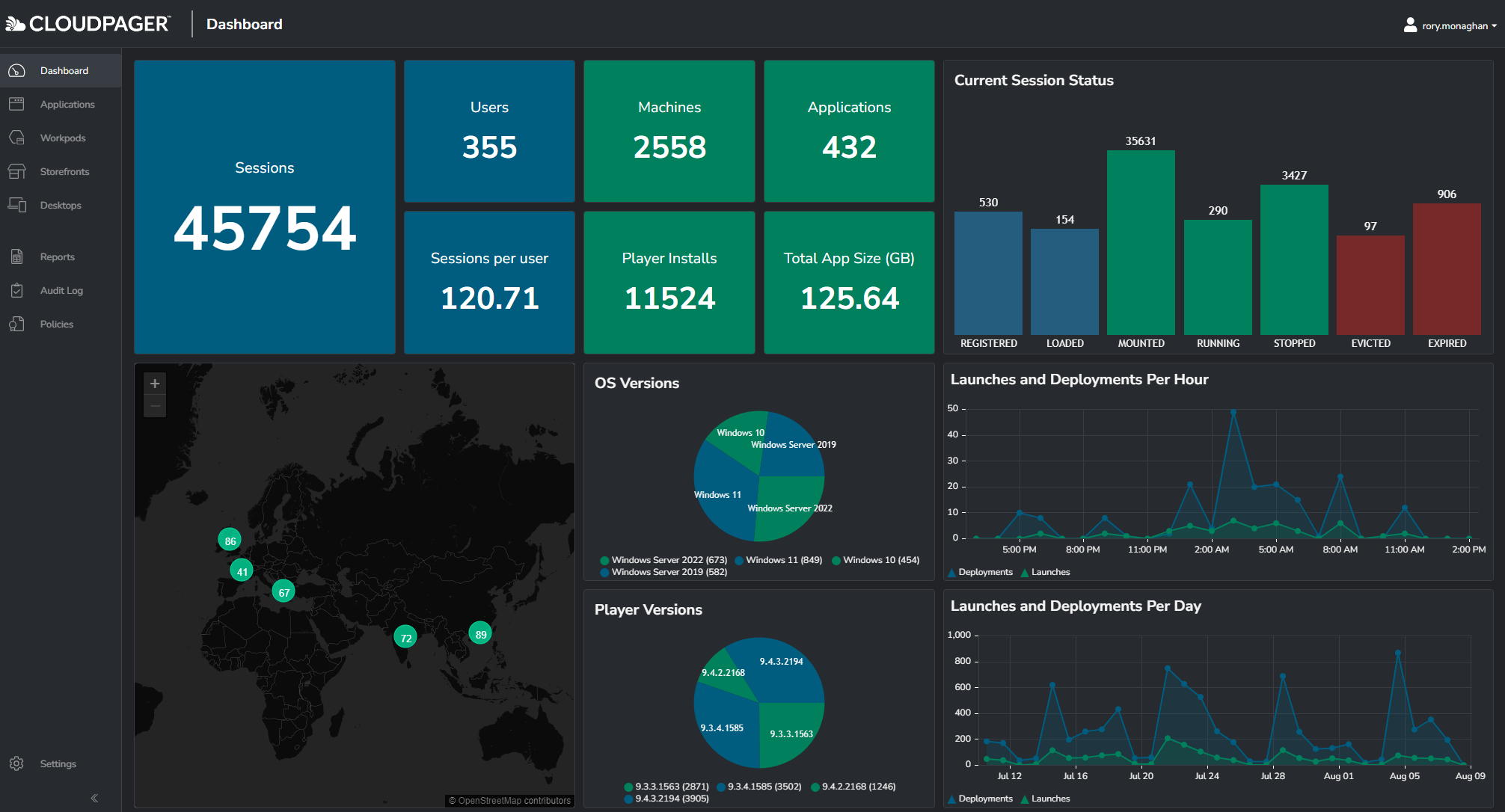
Cloudpager provides real-time insights into your application estate. Dashboards include information on application deployments across all your physical and virtual desktops, including desktop session status, critical application launch and deployment data, product versioning, and more.
Learn MoreWhy a Great DEX Requires Modernizing Application Management
There is still a major area being overlooked by vendors and enterprises when it comes to delivering an optimal DEX. That is the applications. Application-related issues can be complicated. If you rely on user sentiment to point out that a problem they are facing is an application issue, you will be let down. The employees are typically not technical. They do not understand what is an application issue, a network issue, a storage issue, etc. Not only that, but field technicians and service desk members also may not diagnose application issues correctly, particularly when being measured on time to resolution. They may simply re-image a desktop, categorise as a desktop problem and move on with their day.
There is so much productivity lost and frustration experienced due to application issues and when the underlying problems are never addressed, they are doomed to repeat.
Employees who work on computers rely on applications. Without functioning applications, they cannot work. The applications are the main component in DEX. Delivering a good DEX requires modernising the management of applications.
The definition of insanity is doing the same thing and expecting a different result. While DEX is an awesome initiative within your organisation, you must account for more than the data and user sentiment will tell you. You need to take a holistic approach and look at every aspect of your IT services and how you can improve them.
For EUC teams, you should embrace DEX platforms to enrich your data with user sentiment and empower your employees to fix some of the issues they encounter on their own using a DEX platform but you must also look at the key component all employees rely on for doing their work. The Applications! You must modernize how you manage your applications to eliminate application install failures, failed application updates, incomplete uninstalls, application conflicts and more. These are the issues that plague IT but often go overlooked.
Subscribe to the Office of the Technologist
The Office of the Technologist evaluates the latest methodologies, Windows technologies, and industry trends to determine the best approach for delivering and optimizing modern, enterprise-grade IT operations. Fill out the form below to be among the first to hear about the latest content.


